A new approach to analysing and developing arguments
Introducing the argument claim hexagon model
Key points
I've developed a new model to help people analyse and develop arguments more effectively. You can read a short explanation of it below.
I've set up a new website at ArgumentAcademy.com to develop these ideas in more detail.
I will be continuing with this newsletter but I'm also setting up a new Argument Academy newsletter. So if you're interested in reasoning and the structure of arguments, I'd recommend subscribing to that too.
The current problem with argument and reasoning
Arguments are central to our lives as human beings.
We cannot function without having discussions about competing descriptions of reality:
what we do as societies and countries is founded on reasoning and argument
much of what we read and talk about involves reasoning and argument
good decisions cannot be made without recourse to reasoning and argument.
Yet although reasoning and argument are critical to humans, few people spend much time on understanding the structure of arguments or improving their reasoning skills.
Reasoning involves thinking – and thinking is often considered excessively hard work.
In addition, I'm not sure that many of our existing models for understanding reasoning and argument work effectively.
The argument claim hexagon model: A possible solution
I've developed the argument claim hexagon model to help people understand the structure of arguments more clearly.
The model takes the six categories of claim that can be made in an argument and, by putting them in a hexagon, allows a visual representation of the structure of an argument.
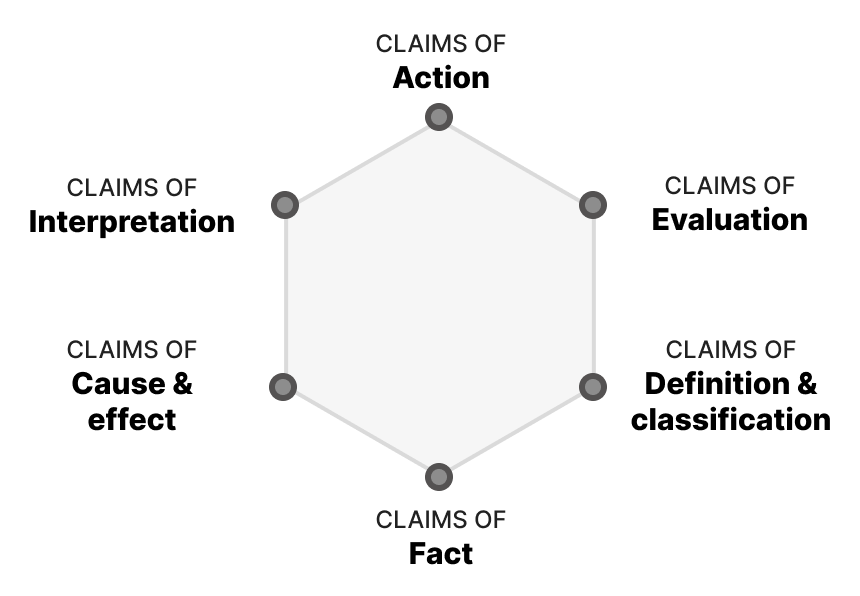
The six different categories of claim are::
Fact – what is true or false?
Cause and effect – what causes what?
Definition and classification – how should something be defined or classified?
Interpretation – how should something be understood?
Evaluation – is something good or bad?
Action – what should be done?
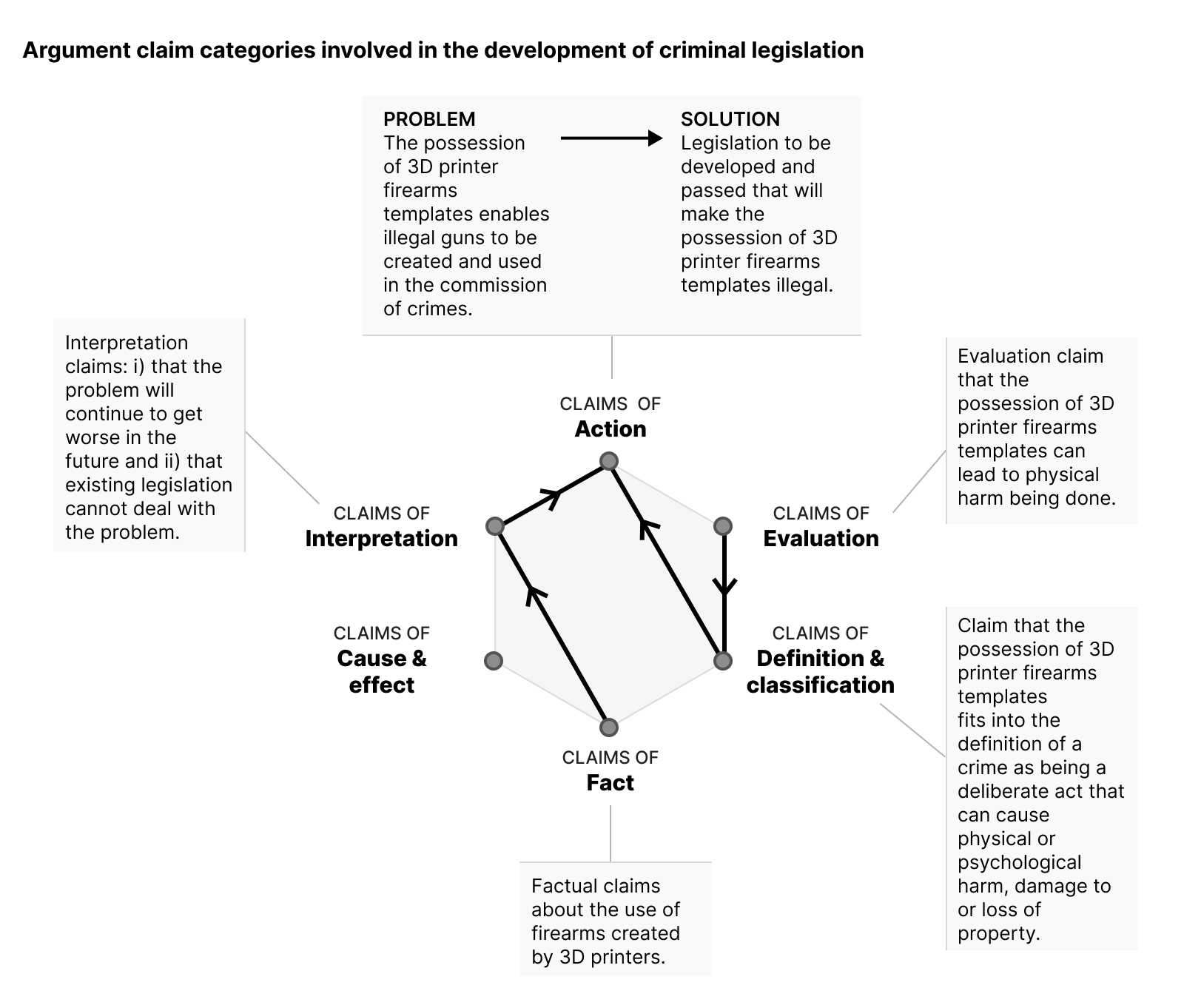
The diagram below shows how the different types of claim might relate to each other in the development of legislation making the possession of 3D printer templates illegal. (Click on the image to see a larger version.)
Potential benefits
Here are four potential benefits of using the model:
It provides a systematic way to identify not just the different claims involved in an argument but also how these claims relate to each other. It therefore enables one to identify the primary, subsidiary and secondary claims in an argument.
The visual nature of the hexagon allows a quicker understanding of the structure of an argument than if the explanation had just been presented in words.
Identifying the explicit structure of an argument makes it easier to check the gaps in someone else’s argument and to challenge it more effectively.
When one is developing an argument oneself, it allows the systematic mapping of the structure of the argument so one can ensure that it’s as complete as possible.
Full article
You can read the full article by clicking on the button below.
New Argument Academy newsletter
If you'd like to subscribe to the new Argument Academy newsletter, please click on the button below and sign up.
As ever, I’d be delighted to hear from you if you have any comments or thoughts. Just reply to this email.
Best wishes,
Francis
==================
Francis Miller